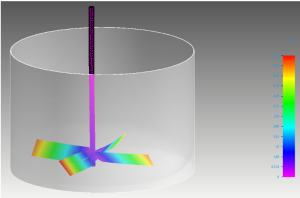
FLOEFD simulation
At Veenstra Technology, we understand that every mixing process has unique flow and mixing requirements. That’s why we offer customized solutions designed to perfectly match the specific requirements of your process. One of these solutions is FLOEFD: an advanced CFD simulation program that allows us to accurately analyze and optimize mixing processes. With this technology, we can design an efficient, reliable and energy-efficient agitator that perfectly fits your specific process.
Advanced CFD analysis with FLOEFD
FLOEFD was developed specifically to simulate the behavior of fluids in a tank. This allows us to determine the optimal flow and mixing for the ideal agitator design. In addition, we calculate the forces and loads on the tank and agitator components, reducing wear and extending the life of your equipment. By importing our CFD simulations directly into our FEM package, we can even more accurately determine the forces on the agitator during the mixing process. This gives us a complete picture of the load and ensures that the design is not only efficient, but also durable. By including properties such as viscosity, density and temperature in the simulation, we guarantee an agitator solution that is perfectly matched to your process goals.
Detailed process analysis for efficient solutions
At Veenstra Technology, we go beyond just simulating fluid flows. Our software also provides a visual representation of how different fluids mix in the tank, giving you insight into the complete mixing process. Our experts perform a thorough analysis based on these simulations, enabling us to recommend an agitator specifically tailored to your unique process conditions.
The program allows us to simulate and calculate critical parameters,
such as:
- Mixing time: how long it takes to achieve a homogeneous mixture;
- Required power: the power required to achieve the desired mixing result, which affects the energy efficiency of your process;
- Settling solids: the rate and extent to which solids can separate from the liquid, which is important for processes where suspensions occur.
Best quality agitators with our expertise
Our approach is based on precision and craftsmanship, with a focus on efficiency, durability and performance. That’s why we use the latest technologies, such as FLOEFD. By working closely with our engineers and simulation experts, we provide you with an agitator that not only meets your requirements, but also optimizes your process. We ensure that your agitator is fully matched to your tank, medium and mixing process so that you achieve the best results with minimal energy and maintenance costs. With years of industry experience and in-depth knowledge of mixing processes, we understand our customers’ unique challenges and ensure that every process runs smoothly and efficiently.
Are you looking for an agitator that is fully tailored to your production process? Contact us for a custom simulation and find out how we can optimize your mixing process.
Case studies
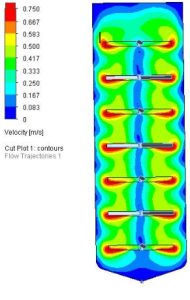

On the left you can see several pitch blades in a narrow high tank. In this, the velocity of the medium is simulated. It can be seen that the velocity of the medium is highest near the pitchblades.
On the right you can see the gate agitator with bottom bearing. This also shows the speed of the medium. The arrows in the illustration show the direction in which the medium is moving. The color indicates the size of the speed at which the medium is moving.

This illustration shows two intermig impellers with a bottom impeller as the lower stirring body. Shown is the mixing image of two liquids. Once the color is the same throughout the tank, it means that the two liquids are well mixed. This can be used to determine the mixing time of multiple mediums.
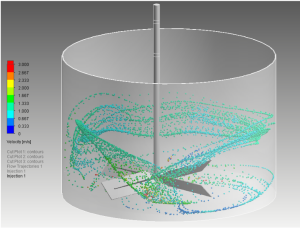
A large four-blade pitchblade in a tank in which the settling of a solid was the problem. The beads in the tank simulate these particles. By simulating the liquid flow and adding the particles to it, we can simulate whether the solid settles. With this, we can confidently put together an agitator that prevents settling.
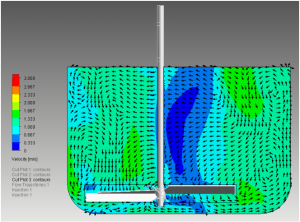
This is the same four-blade pitchblade. Here, like an earlier image, the velocity of the medium is simulated. The arrows in the image show the direction in which the medium is moving.
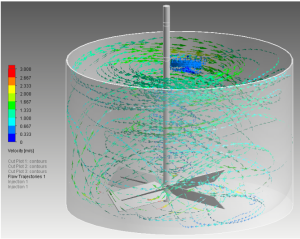
This image also shows the speed of the medium and the direction in which it is moving. Now only in 3D throughout the tank.
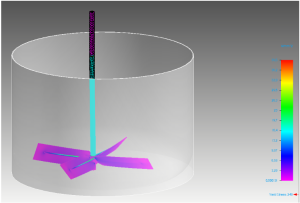
This is the force calculation of the four-blade pitchblade. The pressure of the fluid is placed as a force on the rudder body, from this it can then be determined if the shaft and rudder body are sufficiently strong. Pictured above is the tension occurring in the material, below is the deflection of the rudder body and rudder shaft.