Bespoke fluidisation bed
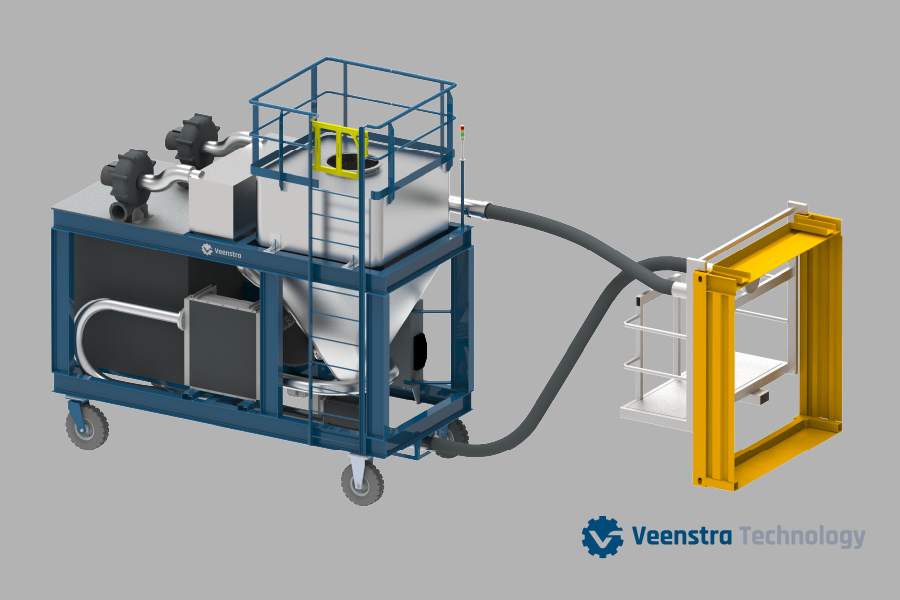
Our client supplies food, agricultural, financial and industrial products and services worldwide. It supplies industrial users of energy, salt, starch and steel products. It develops and sells sustainable products made from renewable agricultural raw materials. Veenstra was approached by the client to design a fluidisation bed for an existing silo used to store powdered products. Veenstra’s engineers subsequently designed a base in which the product is fluidised across the entire cone using air. This cone ensures that no product accumulates (bridging) when the product is discharged from the silo.
Read more
Fluidisation cloth
As a fine powder compacts easily and accumulates quickly (bridging), the entire cone is fitted with a FDA (food-grade) fluidisation mesh that is air-permeable. To hold the seamless fabric in place and ensure it is properly aerated, the fabric is secured with polished stainless steel mounting frames. Thanks to the design and smooth surface of the mounting frames, very little product will remain on or around them. The fluidisation bed can operate at minimal air pressure, ensuring that the mesh does not bulge.
Rising demand for fluidisation
As bulk transport by road has increased in recent years, a short loading time has become more important. As a result, loading speeds have been steadily increased in recent years. This increased loading speed generates significantly more dust during the loading process, and a dust-free loading system is increasingly becoming a requirement.
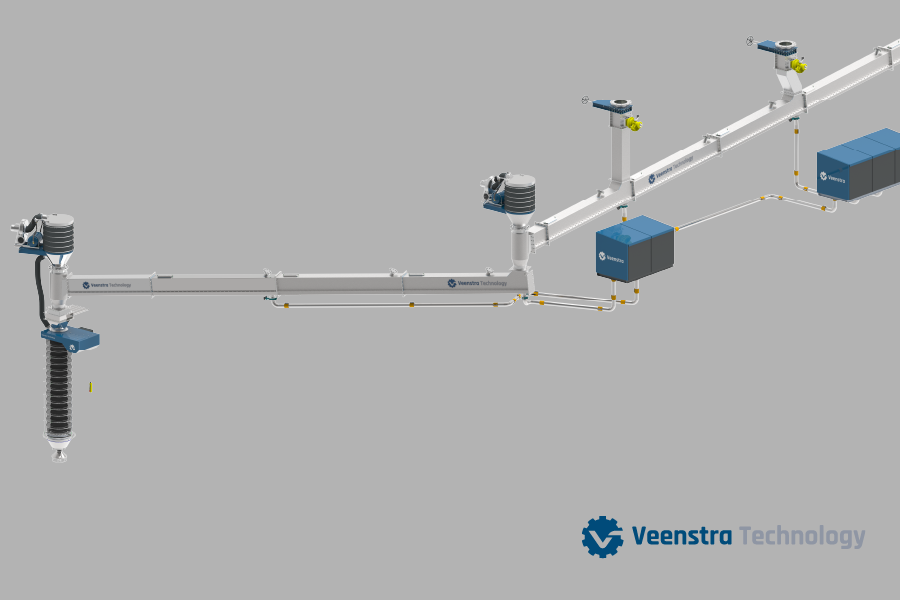
The use of loading chutes with extraction is a good starting point for designing a dust-free loading system. Such loading bellows ensure that any dust generated is efficiently extracted. However, it is even more efficient to prevent dust formation at an earlier stage by preventing bridging in the silo. Bridge formation can be prevented by means of fluidisation. A combination of fluidisation and loading chutes with extraction ensures that bulk lorries are loaded very quickly and dust-free. For this reason, Veenstra Technology is increasingly being involved in the design of new silos and in the conversion of existing silos to a Veenstra system.